


The dental insurance verification process is the workflow a dental practice uses to confirm a patient’s active coverage, eligibility, benefits, deductibles, annual maximums, limitations, exclusions, and other plan details before an appointment or treatment.
A reliable process helps the front desk identify insurance issues earlier, gives treatment coordinators better information for patient estimates, and provides the billing team with cleaner documentation before claims are submitted.
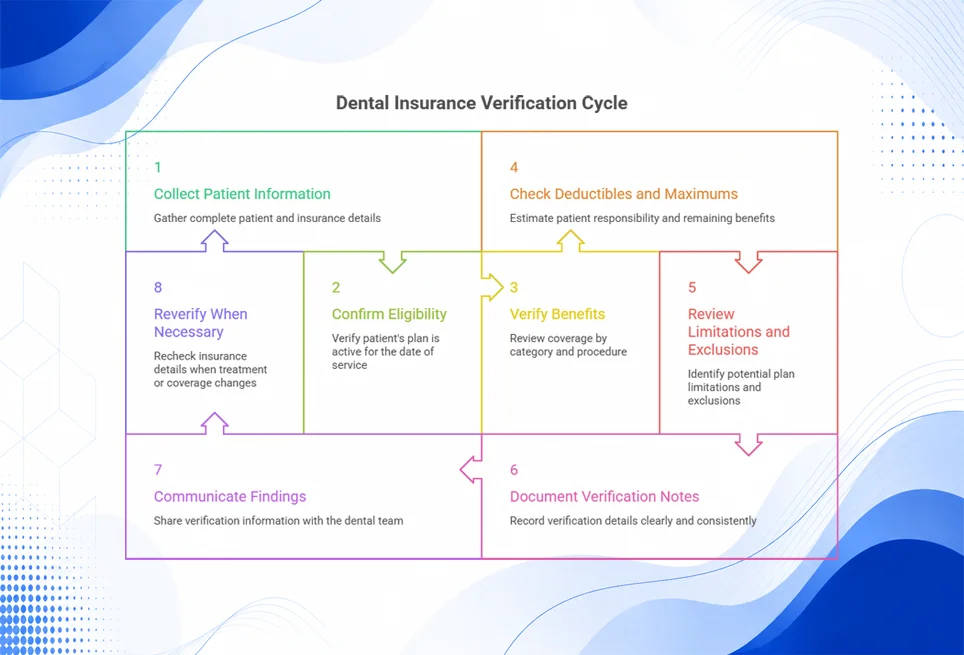
The process generally involves eight steps:
- Collect patient and subscriber information.
- Confirm insurance eligibility.
- Verify dental benefits.
- Check deductibles and annual maximums.
- Review frequencies, waiting periods, and exclusions.
- Confirm secondary or group dental insurance.
- Document verification findings.
- Communicate results and reverify when necessary.
Important: Dental insurance verification helps a practice estimate benefits and patient responsibility. It does not guarantee that an insurance company will pay a claim.
Dental Insurance Verification Process at a Glance
| Step | What the Dental Office Verifies |
|---|---|
| 1. Patient information | Name, DOB, contact information and insurance card |
| 2. Subscriber information | Subscriber name, member ID, group number and relationship |
| 3. Eligibility | Active status, effective date and termination date |
| 4. Benefits | Preventive, basic, major, periodontal and other applicable benefits |
| 5. Financial information | Deductible, deductible met, annual maximum and remaining benefit |
| 6. Limitations | Frequencies, waiting periods, age limits, exclusions and replacement rules |
| 7. Secondary coverage | Primary/secondary order and coordination of benefits |
| 8. Documentation | Verification source, representative, reference number and verification notes |
Need a more detailed front-desk resource? Use our dental insurance verification checklist to create a repeatable checklist for every patient.
What Is the Dental Insurance Verification Process?
The dental insurance verification process is a structured method for confirming the insurance information that may affect a patient’s upcoming dental visit or treatment plan.
It is more than checking whether an insurance plan says “active.”
A complete verification should answer questions such as:
- Is the patient eligible on the expected date of service?
- Is the patient or subscriber information correct?
- What type of dental plan does the patient have?
- What preventive, basic or major benefits may apply?
- Has the deductible been met?
- How much of the annual maximum remains?
- Are there frequency restrictions?
- Are there waiting periods?
- Are there age limitations or exclusions?
- Is there secondary insurance?
- Are there treatment-specific limitations the team needs to know about?
That is why dental insurance verification should be treated as an operational workflow rather than a single eligibility check.
Why Dental Insurance Verification Matters Before Treatment
Dental offices often encounter insurance problems because information is incomplete, outdated or verified too late.
For example:
- A patient’s insurance changed after their last visit.
- The patient’s coverage is active, but the scheduled service has a frequency limitation.
- A deductible has not yet been met.
- The annual maximum is nearly exhausted.
- A major service has a waiting period.
- A crown or prosthetic service has a replacement limitation.
- The patient has two policies and the coordination-of-benefits order is unclear.
Finding these issues before the appointment gives the dental team more time to investigate and communicate with the patient.
It also creates a cleaner handoff between scheduling, treatment coordination and dental billing services.
Step-by-Step Dental Insurance Verification Process
Step 1: Collect Complete Patient and Subscriber Information
Every verification begins with accurate patient information.
For new patients, collect the information before the first appointment whenever possible.
Confirm:
- Patient’s full legal name
- Date of birth
- Phone number
- Address
- Current insurance carrier
- Member or subscriber ID
- Group number
- Subscriber’s full name
- Subscriber’s date of birth
- Patient’s relationship to the subscriber
- Employer information when required
- Front and back of the insurance card
- Secondary insurance information, if applicable
Returning patients should also be asked whether their insurance has changed since their last visit.
A simple question such as:
“Has your dental insurance changed since your last appointment?”
can prevent the practice from spending time verifying an outdated plan.
Why accurate subscriber information matters
Eligibility searches often depend on an exact match between the information submitted by the dental office and the payer’s records.
A nickname, incorrect date of birth, wrong member ID or outdated subscriber information may prevent a portal or verification system from finding the patient correctly.
Clean information makes every later stage of the dental insurance verification process easier.
Step 2: Confirm Dental Insurance Eligibility
The next step is determining whether the patient’s dental plan appears active for the expected date of service.
Eligibility can often be checked through:
- A payer portal
- A dental clearinghouse
- Practice management software
- Insurance verification software
- Electronic eligibility tools
- A payer phone call
- A third-party verification team
Confirm:
- Active or inactive status
- Effective date
- Termination date, when available
- Plan type
- Subscriber match
- Dependent eligibility
- Network information when relevant
Eligibility verification is not benefit verification
This distinction is important.
An eligibility response may confirm that the patient’s policy is active, but it does not necessarily tell the dental office whether a particular procedure will qualify for benefits.
That information is addressed in the next stage.
Step 3: Verify Dental Benefits for the Planned Visit
Once eligibility has been confirmed, review the benefit categories that are relevant to the appointment.
The objective is not always to collect every possible benefit contained in the policy.
The objective is to obtain enough information to support the scheduled visit and anticipated treatment conversation.
Preventive and diagnostic benefits
For hygiene or preventive visits, check items such as:
- Periodic exams
- Comprehensive exams
- Prophylaxis
- Bitewing X-rays
- Full-mouth X-rays
- Panoramic X-rays
- Fluoride
- Sealants
Basic and restorative benefits
For restorative treatment, the practice may need to review:
- Fillings
- Build-ups
- Root canal treatment
- Extractions
- Periodontal treatment
- Oral surgery
Major dental benefits
For more complex treatment, verify details relating to:
- Crowns
- Bridges
- Dentures
- Partials
- Implants when applicable
- Prosthetic replacement
- Major restorative procedures
Coverage percentages alone are not enough.
The dental team should also determine whether frequency rules, deductibles, annual maximums or plan exclusions could affect the estimated benefit.
Step 4: Verify Deductibles and Annual Maximums
A strong dental insurance verification process should help the treatment team understand the patient’s remaining insurance benefit before presenting an estimate.
Confirm:
Deductibles
- Individual deductible
- Family deductible when applicable
- Amount already met
- Remaining deductible
- Whether the deductible applies to preventive services
- Whether different benefit categories have different rules
Annual maximum
Verify:
- Total annual maximum
- Amount already used
- Remaining maximum
- Benefit-year beginning date
- Benefit-year ending date
For example, a patient may have 80% coverage for a basic procedure but still have an unmet deductible.
Another patient may have a high coverage percentage but only a small amount remaining in their annual maximum.
Both situations can materially change the estimated patient portion.
The practice should present insurance amounts as estimates rather than promises of payment.
Step 5: Review Frequency Limits, Waiting Periods and Exclusions
Limitations are one of the most important parts of dental benefit verification.
A procedure may appear covered when the team first reviews the plan, but an additional limitation may change the expected benefit.
Frequency limitations
Check how often services may qualify for benefits, including:
- Exams
- Cleanings
- Bitewing X-rays
- Full-mouth X-rays
- Panoramic X-rays
- Fluoride
- Sealants
- Periodontal maintenance
- Crowns
- Dentures
- Other replacement procedures
Waiting periods
Verify whether waiting periods apply to:
- Preventive services
- Basic services
- Major services
- Orthodontics
- Other treatment categories
Exclusions and plan limitations
Look for:
- Missing tooth clauses
- Replacement limitations
- Downgrades
- Alternate benefit provisions
- Age restrictions
- Non-covered procedures
- Tooth-specific limitations
- History requirements
- Orthodontic limitations
Plan rules differ between carriers and policies, so dental offices should avoid relying on assumptions based on another patient’s plan.
Step 6: Verify Secondary and Group Dental Insurance
Some patients have more than one insurance policy.
When secondary insurance is involved, identify:
- Primary insurance
- Secondary insurance
- Subscriber information for both plans
- Coordination-of-benefits rules
- Applicable dependent coverage rules
- Remaining benefits under each plan when available
Group dental insurance verification may also require accurate employer, group number or subscriber details to identify the correct policy.
Do not assume that two dental plans will automatically pay the entire remaining balance.
The order of benefits and payer rules should be reviewed before estimating secondary coverage.
Step 7: Document Dental Insurance Verification Clearly
A verification is only useful if the rest of the dental team can understand what was found.
Avoid notes such as:
- “Insurance checked”
- “Active”
- “Verified”
Those notes provide very little information to the treatment coordinator or billing team.
Instead, use a consistent dental insurance verification form or standardized verification note.
Document:
- Date verified
- Person who completed the verification
- Verification source
- Payer portal or clearinghouse
- Insurance representative’s name when applicable
- Call reference number
- Eligibility status
- Effective date
- Termination date when available
- Benefit percentages
- Deductible
- Deductible met
- Annual maximum
- Maximum used
- Remaining benefit
- Frequencies
- Waiting periods
- Exclusions
- Secondary insurance
- Unresolved questions
A structured form makes dental insurance verification training easier because new team members have a defined process to follow.
For a more detailed template, see our dental insurance verification checklist and form guide.
Step 8: Communicate Findings and Reverify When Needed
Insurance information should not remain buried in a note that nobody reviews.
The appropriate team members need the information before treatment.
Front desk
The front desk should know about:
- Inactive coverage
- Missing insurance information
- Incorrect subscriber details
- Insurance changes
- Information that still requires patient confirmation
Treatment coordinator
The treatment coordinator may need:
- Coverage percentages
- Deductibles
- Remaining maximums
- Waiting periods
- Frequencies
- Procedure-specific limitations
Billing team
The billing team may need:
- Correct payer information
- Subscriber information
- Coordination-of-benefits details
- Verification notes
- Reference numbers
- Treatment-specific insurance findings
A clean verification workflow can also reduce unnecessary downstream billing investigation and accounts receivable follow-up.
When should dental insurance be reverified?
Reverify when:
- The patient’s insurance changes.
- A new benefit year begins.
- Secondary insurance is added.
- The patient changes employers.
- Major treatment is planned.
- The treatment plan changes significantly.
- The patient returns after a long absence.
- Existing verification information appears incomplete.
- The insurance card or subscriber information changes.
Verification should be treated as current operational information rather than something that is permanently valid once entered.
Dental Insurance Verification Form: What Should It Include?
A dental insurance verification form gives staff a consistent place to capture benefits and coverage information.
A useful form can contain the following sections:
| Form Section | Information to Capture |
| Patient | Name, DOB and contact information |
| Subscriber | Name, DOB, member ID, relationship and group number |
| Plan | Carrier, payer ID, plan type and effective date |
| Eligibility | Active status and termination date |
| Benefits | Preventive, basic, major, periodontal and other applicable categories |
| Financial | Deductible, amount met, annual maximum and remaining maximum |
| Limitations | Frequencies, waiting periods, exclusions and replacement rules |
| Secondary insurance | Primary/secondary order and coordination notes |
| Verification record | Portal, representative, reference number, verified by and date |
Some practices refer to this as a benefit breakdown dental insurance verification form because it creates a structured breakdown of the patient’s benefit information.
The format can be digital or paper-based, but the information should be standardized across the office.
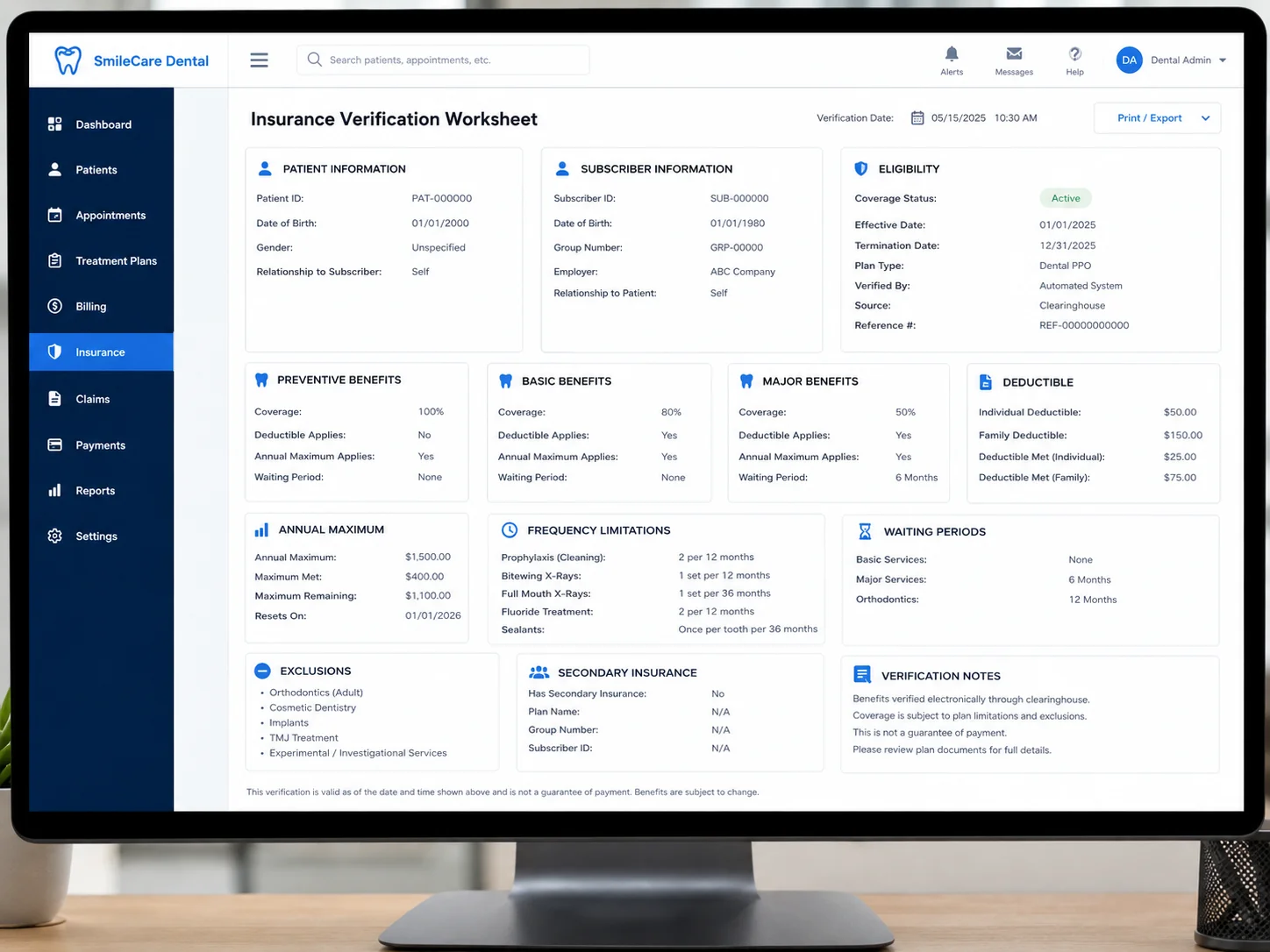
How Dental Offices Verify Insurance?
There is no single verification method that fits every dental practice.
The process may involve one or several tools.
Payer Portals
Dental staff can access insurer portals directly to retrieve eligibility and benefit information.
Portals can be useful for basic information, but the depth of information available varies by payer.
Clearinghouses and Electronic Eligibility Tools
Clearinghouses can help practices obtain electronic eligibility information across multiple payers.
For example, practices researching dental insurance verification for Change Healthcare may encounter the company’s network connectivity and eligibility tools, now presented within Optum’s broader network environment.
Electronic responses can make the first stage of verification faster, but treatment-specific limitations may still require additional review.
Phone Verification
Payer calls may still be necessary when:
- Portal information is incomplete
- Treatment-specific details are unclear
- Replacement history needs confirmation
- Frequency information is missing
- Coordination of benefits is unclear
- A response appears inconsistent
Whenever a call is made, document the representative’s name, reference number and date of verification.
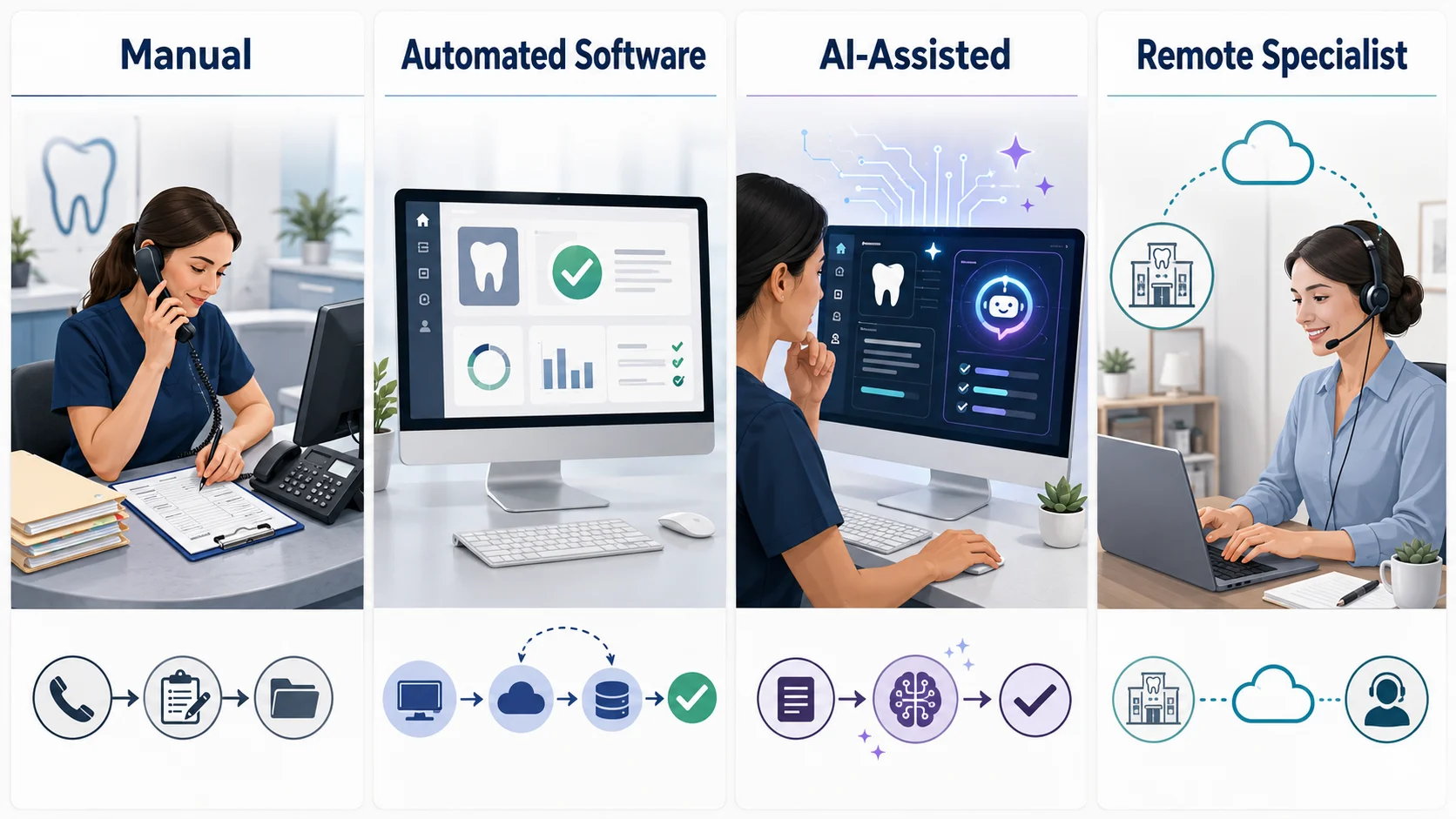
Manual vs Software vs AI vs Outsourced Dental Insurance Verification
Dental practices increasingly have several ways to manage verification.
Understanding the differences helps a practice build a dental insurance verification solution that matches its schedule, staffing and treatment mix.
| Verification Method | Best Fit | Strength | Limitation |
| Manual in-house verification | Lower-volume offices with experienced staff | Direct internal control | Consumes front-desk time |
| Verification software | Practices needing faster electronic checks | Automation and speed | Benefit depth varies |
| Dental insurance verification AI | Practices seeking automated data retrieval and workflow assistance | Can reduce repetitive work | Human review may still be needed |
| Dental insurance verification specialist | Practices with detailed benefit workflows | Human interpretation and follow-up | Requires dedicated staffing |
| Outsourced verification | Busy or growing dental practices | Reduces internal workload | Requires good onboarding and communication |
| Hybrid process | Practices wanting automation plus human review | Flexible | Requires clear task ownership |
Dental Insurance Verification Software and Automation
Practices comparing the best dental insurance verification software should look beyond whether a platform simply returns active eligibility.
Important comparison points include:
- Payer connectivity
- Depth of benefit information
- Practice management system integration
- Automated eligibility checks
- Treatment-specific details
- Frequency information
- Documentation workflow
- Secondary insurance handling
- Human review options
- Security and access controls
The best automated dental insurance verification software for one dental office may not be the best option for another.
A general practice with mostly preventive visits may have different requirements than a multi-location practice handling complex restorative, periodontal or implant treatment.
When evaluating the most reliable insurance verification tools for dental practices, focus on how accurately the tool supports your actual verification process rather than simply how many features it advertises.
Dental insurance verification software comparison
A useful dental insurance verification software comparison should evaluate:
- What information is retrieved automatically.
- Which payers are supported.
- Whether detailed benefits are available.
- How data enters the practice management workflow.
- Whether staff must manually review results.
- What happens when electronic payer information is incomplete.
- Whether human verification or payer calls are available.
Practices researching the best insurance verification software for dental should compare software against their actual workload instead of treating automation as an automatic replacement for human verification.
Dental Insurance Verification AI
Dental insurance verification AI can help automate repetitive tasks such as retrieving, organizing or interpreting insurance information.
Practices researching the top dental AI for insurance verification should evaluate accuracy, payer coverage, workflow integration, human oversight and how the system handles incomplete or conflicting insurance data.
AI can support the verification process, but offices still need clear procedures for reviewing information and escalating exceptions.
What are the best options for automating dental insurance verifications?
The main options include:
- Practice management integrations
- Electronic eligibility systems
- Dental verification software
- AI-assisted verification
- Clearinghouses
- Hybrid automation plus human verification
- Outsourced verification teams using software-supported workflows
The best approach depends on patient volume, payer mix, treatment complexity and internal staffing.
Dental Insurance Verification Specialist vs Outsourcing
A dental insurance verification specialist is a team member or remote professional whose primary responsibility is verifying patient insurance information.
The specialist may:
- Check eligibility
- Obtain benefit breakdowns
- Review deductibles
- Confirm annual maximums
- Investigate frequency limitations
- Identify waiting periods
- Verify secondary coverage
- Contact payers
- Document results
Dental practices that do not want to hire additional internal staff may instead consider dental insurance verification outsourcing.
When should a practice outsource dental insurance verification?
A practice may consider outsourcing dental insurance verification when:
- Front-desk staff cannot complete verification before appointments.
- Staff spend excessive time contacting payers.
- Benefit notes are inconsistent.
- New-patient volume is growing.
- Treatment coordinators regularly wait for benefit details.
- Insurance verification interrupts patient-facing work.
- Staff turnover affects verification consistency.
- The practice needs additional verification capacity without another full-time internal hire.
Practices can outsource dental insurance verification through a dedicated support provider or use a hybrid model in which software handles electronic eligibility and specialists handle exceptions or detailed benefits.
Third-Party Dental Insurance Verification Services
A third-party dental insurance verification provider performs some or all verification activities outside the dental practice’s internal team.
Dental offices comparing dental insurance verification services or an insurance verification company for dental practices should evaluate the provider’s workflow rather than choosing solely on price.
Look for:
- Dental-specific experience
- Standard verification procedures
- Clear documentation
- Ability to verify treatment-specific benefits
- Payer-call capability
- Secure handling of patient information
- Defined turnaround expectations
- Escalation procedures
- Consistent communication
- Integration with the practice’s existing workflow
The best dental insurance verification companies should make it clear what they verify, how they document results and what happens when insurance information cannot be confirmed electronically.
A provider should complement the dental practice’s process rather than create another disconnected workflow.
Learn more about dental insurance verification services for dental practices.
Does the Dental Insurance Verification Process Change by State?
The basic verification workflow remains largely consistent across dental practices, but payer mix, employer plans, networks and practice workflows can differ by market.
That means offices researching:
- Arizona dental insurance verification
- California dental insurance verification
- Dental insurance verification in California
- Nevada dental insurance verification
- Utah dental insurance verification
- New York dental insurance verification services
- San Diego dental insurance verification services
- San Francisco dental insurance verification services
should still begin with the same core process:
patient information → eligibility → benefits → financial limits → exclusions → documentation → communication.
The same principle applies when choosing software.
A practice searching for dental insurance verification software in California, New Jersey, New York, San Diego or San Francisco should prioritize payer connectivity, workflow compatibility and verification depth rather than choosing a system simply because it is marketed for a particular city.
Dental Insurance Verification Training and Quality Control
A reliable process depends on training.
Dental insurance verification training should teach staff not only where to find insurance information, but also what the information means and how it should be documented.
Training should cover:
Patient and subscriber data
Staff should understand what information is needed to obtain a reliable eligibility response.
Eligibility versus benefits
Team members should understand that active eligibility alone does not confirm procedure-level benefits.
Dental terminology
Verification staff should recognize common benefit categories, frequencies, deductibles, annual maximums and exclusions.
Documentation standards
Everyone should use the same verification format.
Escalation rules
Staff need to know when to:
- Call a payer
- Ask the patient for updated information
- Reverify treatment
- Escalate unclear benefits
- Contact the treatment coordinator
- Flag information for the billing team
Quality review
Office managers can periodically review verification notes for missing information, inconsistent formatting and recurring payer issues.
A standardized workflow makes training easier and reduces dependence on individual staff habits.
Common Dental Insurance Verification Mistakes
| Mistake | Better Process |
| Checking only active eligibility | Verify relevant benefits and limitations |
| Waiting until the patient arrives | Verify before the appointment whenever practical |
| Using old insurance information | Ask returning patients whether coverage changed |
| Ignoring frequency restrictions | Check service-specific limitations |
| Missing deductible information | Confirm deductible and amount met |
| Forgetting the annual maximum | Check total, used and remaining benefits |
| Missing waiting periods | Review plan-specific waiting rules |
| Ignoring secondary coverage | Confirm coordination of benefits |
| Writing vague verification notes | Use a standardized verification form |
| Treating estimated benefits as guaranteed payment | Explain that insurance payments remain subject to payer processing |
| Failing to reverify major treatment | Recheck when treatment or coverage changes |
Find Hidden Verification Gaps
Strengthen Your Dental Insurance Verification Process
Mergant Support helps dental practices spot workflow delays, missed benefit details, and verification issues before they turn into billing problems.
Book a Free Workflow ReviewHow to Improve Your Dental Insurance Verification Process
A better process does not necessarily mean adding more steps.
It means creating a repeatable system.
Start with these improvements:
- Collect insurance information before the appointment.
- Use one standardized verification checklist.
- Separate eligibility verification from detailed benefit verification.
- Verify information relevant to the scheduled treatment.
- Document every verification in a consistent format.
- Establish rules for payer calls and unresolved questions.
- Make verification information accessible to the front desk, treatment coordinator and billing team.
- Reverify when insurance or treatment changes.
- Decide which steps should be manual, automated or outsourced.
- Review recurring errors and improve the workflow.
Dental offices should aim for a process that gives the right information to the right team member at the right time.
How Mergant Support Helps Dental Practices With Insurance Verification
Mergant Support provides remote operational support for dental practices that want a more consistent verification workflow without putting every insurance task on the front desk.
Support can include:
- New-patient dental insurance verification
- Returning-patient eligibility checks
- Benefit breakdowns
- Deductible review
- Annual maximum review
- Frequency checks
- Waiting-period review
- Secondary insurance verification
- Verification note updates
- Schedule-based verification support
- Coordination with dental billing workflows
For practices considering a dental practice insurance verification service, the goal should be to create a workflow that complements existing staff, software and billing procedures.
Explore our dental insurance verification services or learn about our broader insurance verification support.
Dental Insurance Verification Process FAQs
What is the dental insurance verification process?
The dental insurance verification process is the workflow a dental office uses to confirm eligibility, benefits, deductibles, annual maximums, frequencies, waiting periods, exclusions and other plan details before an appointment or treatment.
What information is needed for dental insurance verification?
Dental offices commonly need the patient’s full name, date of birth, insurance card, member ID, group number, subscriber information, relationship to the subscriber and secondary insurance details when applicable.
Is dental eligibility verification the same as benefit verification?
No. Eligibility verification confirms whether the patient’s coverage appears active. Benefit verification examines what the plan may cover and which deductibles, annual maximums, frequencies, waiting periods or exclusions may apply.
How early should dental insurance be verified?
The best timing depends on the practice’s schedule, staffing and treatment type. The goal is to verify early enough to correct missing information or investigate unclear benefits before the patient’s visit.
What is a dental insurance verification form?
A dental insurance verification form is a standardized document used to record patient information, subscriber details, eligibility, benefits, deductibles, maximums, limitations, secondary coverage and verification notes.
Build a More Reliable Dental Insurance Verification Process
The best dental insurance verification process is not simply the fastest one.
It is the process that consistently gives your front desk, treatment coordinator and billing team the information they need before treatment begins.
Collect accurate patient information, confirm eligibility, verify relevant benefits, investigate limitations, document everything clearly and create a defined process for rechecking insurance when circumstances change.
If verification work is overwhelming your front desk or delaying benefit information, Mergant Support’s dental insurance verification services can help you build a more structured workflow.
Want a Smoother Verification Process?
Improve Your Dental Insurance Verification Workflow
Now that you understand the key steps, your dental team should not have to manage every verification task manually while handling calls, patients, scheduling, and billing questions.
Mergant Support can review your current insurance verification process, identify workflow gaps, and show how dedicated remote support can help your practice verify benefits earlier and document details more clearly.
Book a Free Workflow Review